 Psychotic Reactions and Carburetor Dung: The Work of a Legendary Critic: Rock’N’Roll as Literature and Literature as Rock ‘N’Roll by Lester Bangs
My rating: 4 of 5 stars
One of the few books I still have from my high school years.

Psychotic Reactions and Carburetor Dung: The Work of a Legendary Critic: Rock’N’Roll as Literature and Literature as Rock ‘N’Roll by Lester Bangs
My rating: 4 of 5 stars
One of the few books I still have from my high school years.
 I just bought this book today. The first poem I read, and absolutely love, is by Kevin Young:
Eddie Priest’s Barbershop & Notary
Closed Mondays
is music is men
off early from work is waiting
for the chance at the chair
while the eagle claws holes
in your pockets keeping
time by the turning
of rusty fans steel flowers with
cold breezes is having nothing
better to do than guess at the years
of hair matted beneath the soiled caps
of drunks the pain of running
a fisted comb through stubborn
knots is the dark dirty low
down blues the tender heads
of sons fresh from cornrows all
wonder at losing half their height
is a mother gathering hair for good
luck for a soft wig is the round
difficulty of ears the peach
faced boys asking Eddie
to cut in parts and arrows
wanting to have their names read
for just a few days and among thin
jazz is the quick brush of a done
head the black flood around
your feet grandfathers stopping their games of ivory
dominoes just before they reach the bone
yard is winking widowers announcing
cut it clean off I’m through courting
and hair only gets in the way is the final
spin of the chair a reflection of
a reflection that sting of wintergreen
tonic on the neck of a sleeping snow
haired man when you realize it is
your turn you are next
Word of Mouth: Poems Featured on NPR’s All Things Considered
The public library has become my new bookstore. Yesterday, I went book shopping there and got the following books:
 Palestine: Peace Not Apartheid by Jimmy Carter
If you know me, then you know I am in no way, shape or form, a supporter of mainstream politics, let along presidents of the united states, former or current. However watching “history” the day Obama was installed as the “new face” of america, I was struck by the difference in physicality between George, Sr and the “peanut farmer” from Georgia. George, Sr looked like he could barely walk (and old Barbara didn’t seem to want to help him at all – if how far ahead she was walking is any indication). However, the peanut farmer defined sprightly. The image stuck with me and lead me to watch a documentary about said peanut farmer. In that documentary, I learned about this book…and the reaction to it. So even the back cover blurb includes quotes from the bible (something that interests me even less than mainstream politics), I decided to get it and yes, read it.
 A Change of Skin by Carlos Fuentes
On the header over at Whirlwind Publishing, I have a quote from Fuentes: writing is a struggle against silence. When I saw this book, my mind flashed to that quote and also the realization that I had never actually read anything by Fuentes. So the book got added to the small pile. Because I have no experience with him or his writing (aside from the quote), I have no expectations. If A Change of Skins resonates with me enough, I will review it in the future.
 The Hindi-Bindi Club by Monica Pradhan
The cover of this book seems like it was designed to capture the eye of readers who get titillated by the “exoticness” of Indian cultural attire. But what decided me on it was the back blurb which said the following:
In the celebrated tradition of The Joy Luck Club and Like Water for Chocolate comes a lyrical and deeply moving debut that explores the intricate bond between mothers and daughters – and the universal quest to live a life of love, beauty and truth.
This book and the one I’m going to discuss next will be read as part of the 2011 South Asian reading challenge.
 Brick Lane by Monica Ali
Honestly, I bought this book because I’ve seen the movie and want to read the original, as is my wont.
Both books will be reviewed.
Horses Make a Landscape Look More Beautiful – Alice Walker
When I first started reading Black lit as a teenager, this was one of the books I got. Back then my favorite poem in it was First They Said. I think it might actually be the original hardcover book because the picture on the back cover shows a young Alice Walker wearing what looks like braid extensions.
I don’t know if the Heinneman African Writer Series (AWS) was one of those Chess record label deals where the artists didn’t get paid according to the value of their work to the music appreciating audience but rather according to the skinflint economics of record label owners. I haven’t researched it so I can’t say. I can say I sincerely hope not because I am thankful for it connecting me to so many African writers they’ve become part of my interior landscape.
For instance, earlier today, I was mopping my floor and for no reason I can think of one of the stories in Grace Ogot’s Land without thunder crossed my mind. In a beautiful story called the old white witch, a group of african nurses go on strike because they’ve been ordered to carry the feces of patients and that is against their cultural practices. As their spokeswoman, Adhiambo (but called Monica by the white missionaries who run the hospital) says:
Long before you came, we agreed to nurse in the hospital on the understanding that we were not to carry any bedpans. We want to be married and become mothers like any other woman in the land. We are surprised that senior members of the staff have sneaked behind us to support you when they know perfectly well that no sane man will agree to marry a woman who carries a bedpan. A special class of people do this job in our society. Your terms are therefore unacceptable, Matron. You can keep your hospital and the sick. And if being a Christian means carrying faeces and urine, you can keep Christianity too – we are returning to our homes.
I don’t know why this occurred to me in the midst of cleaning but it is a fine, fine story. Land of Thunder is full of such stories. Click the book cover to visit Ogot’s Amazon page.



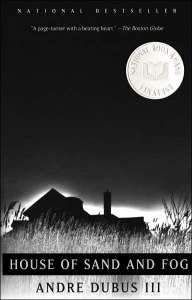 The House of Sand and Fog engaged me from the opening lines when I encountered Massoud Amir Behrani, a colonel under the former Shah of Iran. Now an immigrant in the San Francisco Bay Area, he works back-breaking jobs while trying to maintain the illusion that he, his wife and two children fled Iran upon the Shah’s deposing with all their wealth intact. Upon marrying his daughter to a son of a wealthy Iranian family, he then invests his whole life savings in an auctioned house. He also relocates his wife and teenage son to said house. Behrani’s plan is to upgrade the house and then sell it for a profit, which he can then reinvest in another property (his version of the American dream). Only to get caught up in the undertow of the bureaucracy that not so tightly stitches the dream.
The house that the colonel buys at a county auction was left to Kathy Nicolo by her father. Originally from a Massachusetts town, she and her husband drove out to San Francisco together. Soon after that, Kathy’s husband, Nick, left her. Lost in the emotion of dealing with that, she starts to neglect matters relating to the house; specifically, a letter sent to her by the County stating that because taxes haven’t not been paid, her house is being auctioned.
In other words, this is a very American novel. That is demonstrated clearly near the end of the novel when one character, Kathy Nicolo, is reflecting on everything that happened:
“…it was me letting Lester finish what we’d both started, letting all this happen so I could put off facing my mother and brother with the news that somehow Dad’s house had slipped through my fingers: I’d been willing for Lester to do anything so I could put off that moment of judgment.”
Even though this book has been made into a movie and is itself a few years old, I still don’t want to “spoil” it for someone like myself, who just happens across the book and decides to read it. For that reason, I won’t go into much more detail about the plot. I do, however, recommend you read this piece of americana literature yourself.
Join me on Goodreads
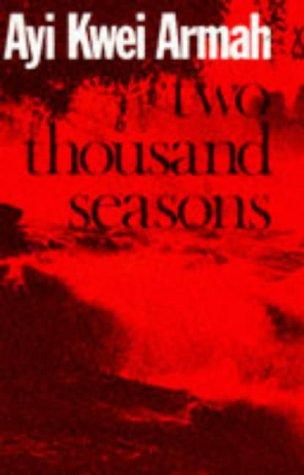 “You hearers, seers, imaginers, thinkers, rememberers, you prophets called to communicate truths of the living way to a people fascinated unto death, you called to link memory with forelistening, to join the uncountable seasons of our flowing to unknown tomorrows even more numerous, communicators doomed to pass on truths of our origins to a people rushing deathward, grown contemptuous in our ignorance of our source, prejudiced against our own survival, how shall your vocation’s utterance be heard?
This is life’s race, but how shall we remind a people hypnotized by death? We have been so long following the falling sun, flowing to the desert, moving to our burial.
In the living night come voices from the source. We go to find our audience, open our mouths to pass on what we have heard. But we are fallen among a fantastic tumult. The noise the hypnotized make, multiplied by every echoing cave of our labyrinthine trap is heavier, a million times louder than the sounds we carry.
Hoarsened, we whisper our news of the way. In derisive answer the hurtling crowds shriek their praise songs to death. All around us the world is drugged white in a deathly happiness while from under the falling sun powerful engines of noise and havoc emerge to swell the cacophony. Against their crashing riot nothing whispered can be heard, nothing said. Indeed the tumult welcomes who would shot and burst the veins on his own neck. His message murdered before birth, the shouter only helps confusion.”
Two Thousand Seasons by Ayi Kwei Armah
 Taking the book solely at face value, Song of Lawino & Song of Ocol are verses concerned with the disintegration of the marriage of Lawino, a rural African (Acoli) woman and Ocol, her western-educated husband. However, peeling back the cover of the words even a tiny bit reveals a woman committed to her indigenous culture versus a man who thinks that her culture needs to be removed from the face of the earth. How could two such people co-exist in the same household? How could two such differing ideologies co-exist on the same planet? According to Ocol, not at all. His song is full of imagery that calls death upon the culture Lawino praises in her song.
We will smash
The taboos
One by one,
Explode the basis
Of every superstition,
We will uproot
Every sacred tree
And demolish every ancestral
shrine.
In Ocol’s song, the thing that is so striking about this book – the use of indigenous Acoli symbols to present a woman solidly rooted in her culture – gets turned on its head. Every thing African becomes associated with death, decay and other imagery meant be extremely negative. However, that is not the case with Lawino. Unlike she does not hate foreign customs. They are simply not hers.
I do not understand
The ways of foreigners
But I do not despise their
Customs.
Of course if things were as simple as that, there would be no need for Lawino to sing her song. For instance, I agree with Ocol’s installing of an electric stove in their house. . Lawino doesn’t know how to use it and is, in fact, scared of it.
I am terribly afraid
Of the electric stove,
And I do not like using it
Because you stand up
When you cook.
Who ever cooked standing up?
And the stove
Has many eyes
I do not know
Which eye to prick
So that the stove
May vomit fire
And I cannot tell
Which eye to prick
So that fire is vomited
In one and not in another plate.
Instead of patiently teaching Lawino the benefits of the stove and how to properly use it, Ocol rails against her. He considers her lack of knowledge one more African deficiency he wants to divorce himself from. His attitude is revealing especially because he later becomes a leader of his country’s independence struggle for Uhuru (freedom). As Lawino tells it, Ocol says
White men must return
To their own homes,
Because they have brought
Slave conditions in the country.
He says
White people tell lies
That they are good
At telling lies
Like men wooing women
Ocol says
They reject the famine relief
Granaries
And the forced-labour system.
After revealing this, Lawino goes on to question an Uhuru where her husband can’t even get along with his brother.
When my husband
Opens a quarrel
With his brother
I am frightened!
You would think
They have not slept
In the same womb,
You would think
They have not shared
The same breasts!
And they say
When the two were boys
Looking after the goats
They were as close to each other
As the eye and the nose,
They were like twins
And they shared everything
Even a single white ant.
Even more astute however, is her statement describing the period of “independence”.
Independence falls like a bull
Buffalo
And the hunters
Rush to it with drawn knives,
Sharp shining knives
For carving the carcass.
And if your chest
Is small, bony and weak
They push you off,
And if your knife is blunt
You get the dung on your
Elbow,
You come home empty-handed
And the dogs bark at you!
In raising questions that center around the concept of post-colonial independence and how such an entity impacts on the consciousness of Africans who have been educated outside of africa as well as rural Africans who have never left the continent, the Song of Lawino & the Song of Ocol ranks up there with Ama Ata Aidoo’s Sister Killjoy. Both Sissie and Lawino were asking the same questions. The current state of the continent provides the answer.
Our women must not pull back in the face of the many different aspects of their struggle, which leads them to courageously and proudly take full charge of their own lives and discover the happiness of being themselves, not the domesticated female of the male. Today, many women still seek the protective cover of a man as the safest way out from all al that oppresses them. They marry without love or joy, just to serve some boor, some dreary male who is far removed from real life and cut off from the struggles of the people.
Often, women will simultaneously demand some haughty independence and at the same time protection, or even worse, to be put under the colonial protectorate of a male. They do not believe that they can live otherwise. No. We must say again to our sisters that marriage, if it brings society nothing positive and does not bring them happiness, is not indispensable and should be even avoided.
Let us show them our many examples of hardy and fearless pioneers, single women with our without children, who are radiant and blossoming, overflowing with richness and availability for others-even envied by unhappily married women, because of the warmth they generate and the happiness they draw from their freedom, dignity and willingness to help others.
Women have shown sufficient proof of their ability to manage the home and raise children – in short, to be responsible members of society – without the oppressive tutelage of a man. Our society is surely sufficiently advanced to put an end to this banishment of the single woman. Comrade revolutionaries, we should see to it that marriage is a choice that adds something positive, and not some kind of lottery where we know what the ticket costs us, but have no idea what we will end up winning. Human feelings are too noble to be subject to such games.
Excerpted from Thomas Sankara Speaks
One of the blogs I follow is Kinna Reads. Today I received in my inbox the following: Link Gems. The gems included Chimamanda Adichie on Ama Ata Aidoo, an essay about the relationship between Toni Morrison’s Beloved and Homer’s Odyssey. As someone who finds herself interested in the interplay of European classics and Black literature, the last is particularly interesting to me. Both are excerpted below.
Chimamanda Adichie on Ama Ata Aidoo:
Aidoo is too good a writer to paint with overly broad brush strokes. She does not suggest that the past was perfect, and there is no romanticising of culture. Instead, she bears witness to the realities of the time, her vision clear-eyed and pitiless, her role simply that of a truth-teller. Aidoo has a fantastic sly wit and humour. She never hits you over the head with any ‘message’, but after you have greedily finished each story, you sit back and realise that you have been through an intellectual experience as well.
Beloved certainly does not wear its Odyssey on its sleeve as brazenly as do O Brother or Ulysses, and, perhaps unlike those works, it can be read insightfully without reference to Homer. On the other hand, the connections between the Odyssey and Beloved in no way diminish Morrison’s novel. Instead, the similarities and differences between the works accomplish something important. By making Beloved a reworking of the Odyssey, Toni Morrison puts her story next to Homer’s—placing the lives and struggles of African Americans past and present into an epic context. She places these experiences alongside a story that is central to Western civilization, thereby asserting their own worthiness and importance in that tradition.
 Diary of a mad reader