Rigoberta Menchu

•March 2, 2011 • Leave a Comment

Rigoberta Menchu Tum

Biography:

Rigoberta Menchú Tum (born 9 January 1959, Laj Chimel, El Quiché, Guatemala) is an indigenous Guatemalan, of the K’iche’ ethnic group. Menchú has dedicated her life to publicizing the plight of Guatemala’s indigenous peoples during and after the Guatemalan Civil War (1960–1996), and to promoting indigenous rights in the country. She received the 1992 Nobel Peace Prize and Prince of Asturias Award in 1998. She is the subject of the testimonial biography I, Rigoberta Menchú (1983) and the author of the autobiographical work, Crossing Borders. Later, American anthropologist David Stoll visited Guatemala and uncovered evidence that some of the claims presented in Menchú’s Nobel Prize-winning testimonial were inaccurate or false.

Menchú is a UNESCO Goodwill Ambassador. She has also become a figure in indigenous political parties and ran for President of Guatemala in 2007.

In 2009 she was involved in the newly founded party Winaq.(source)


Books:

image

These interviews – conducted in Spanish, a language she has spoken for only three years – center on her role as a Quiche woman. Born in the mountains of Guatemala into the Quiche, one of twenty-three mestizo groups, Rigoberta Menchu tells the story of the Quiche fight to keep the Guatemalan gov’t and big-business people from stealing any more of their land: "This is my testimony. I didn’t learn it from a book and I didn’t learn it alone… My personal experience is the reality of a whole people."


                                                                                                                                                                                             imagePart memoir, part political manifesto, this impassioned testimony by the Guatemalan Maya human-rights activist and winner of the 1992 Nobel Peace Prize is a stirring sequel to her 1984 autobiography, I, Rigoberta Menchu.
Book Review: Half of a Yellow Sun

•February 6, 2011 • 1 Comment

Historical fiction is one of my favorite genres – as I frequently approach history through literature. So it was with excitement that I opened Half of a Yellow Sun by Chimamanda Adichie. I knew next to nothing about the backdrop to the novel, the Biafra war. I definitely didn’t know that it was Igbo-based. However, understanding my lack of knowledge, I took what Ama Ata Aidoo wrote in Our Sister Killjoy to be true; that Nigeria "not only has all the characteristics which nearly every African country has but also possesses these characteristics in bolder outline".

I have to admit I was a bit thrown for a loop when the Biafran characters would talk about Nigeria and Nigerians as The Other. Then I remembered a discussion I had with someone about Watch for Me on the Mountain by Forrest Carter. In that book, a fictional rendering of Geronimo’s life, Mexicans were consistently referred to in the negative. I didn’t get that either until I was made to understand that Mexico, as a country, was imposed on Indigenous people from without. Once I understood that, the negative perception of Mexico made a whole lot of sense. It was the same with Nigerian and Nigerians. I have to admit, though, to a little discomfort in understanding (and potentially agreeing with) the Biafran struggle for Independence from Nigeria. After all, one of the giants of African Independence, Kwame Nkrumah, believed strongly in a United States of Africa. Half of a Yellow sun raised questions such as should such a structure be based on the 1885 carving up of Africa?

Originally, I had planned to write an intricate review. However, I must admit, that reading the book soon became a chore. It wasn’t due to book being well over 500 pages. Even though the story was very interesting, the writing itself was unable to hold my interest for a sustained amount of time. Considering all the publicity Adichie has received, I expected a literary masterpiece.Now, don’t get me wrong. It is definitely worth reading; especially for folks like me who look at literature as more than just a good story. It just dragged at several points during the read.

The Resurrecting Writers Series – Home Girls: A Black Feminist Anthology

•January 13, 2011 • 3 Comments


Roaming the blogosphere as I am wont to do, I came across a challenge on calyx press’ blog. Of course, at 43, I do not qualify as a “young feminist” (if I ever did) but still it set me to thinking about my intentions to write a review of Home Girls: A Black Feminist Anthology.

To a young woman unanchored, on the verge of being culturally divorced from self, the anthology was one of a series of buoys clung to and devoured like I was a member of the Donner party – not the daughter of Salma. Comprising both poetry and prose, the book represents discussions black women were having with other black women – and society in general – about what it means to be a black woman. The scope of the conversation is wide-ranging. It includes the Combahee River Collective Statement which includes articulations such as

This focusing upon our own oppression is embodied in the concept of identity politics. We believe that the most profound and potentially most radical politics come directly out of our own identity, as opposed to working to end somebody else’s oppression. In the case of Black women this is a particularly repugnant, dangerous, threatening, and therefore revolutionary concept because it is obvious from looking at all the political movements that have preceded us that anyone is more worthy of liberation than ourselves. We reject pedestals, queenhood, and walking ten paces behind. To be recognized as human, levelly human, is enough.

I’m not entirely clear on the concept of identity politics. However, it does strike me as the essence of self-determination to push your own cause. In the case of black women, the cause should be black women. Home Girls is one of the spots along my literary reading history where I realized it was acceptable, revolutionary even, to come out from the background, open my mouth and express my full self.

Home Girls is also where I first encountered the work of poet Kate Rushin. Her poem, the Black Back-ups,

is dedicated to Merry Clayton, Cissy Houston, Vonetta Washington, Dawn, Carrietta McClellen, Rosie Farmer, Marsha Jenkins and Carolyn Williams. This is for all of the Black women who sang back-up for Elvis Presley, John Denver, James Taylor, Lou Reed, Etc, Etc, Etc.

This is for Hattie McDaniels, Butterfly McQueen, Ethel Waters
Saphire
Saphronia
Ruby Begonia
Aunt Jemima
Aunt Jemima on the Pancake Box
Aunt Jemima on the Pancake Box?
AuntJemimaonthepancakebox?
auntjemimaonthepancakebox?
Ainchamamaonthepancakebox?
Aint chure Mama on the pancake box?

Mama Mama
Get offa that damn box
And come home to me

And my Mama leaps offa that box
She swoops down in her nurse’s cape
Which she wears on Sunday
And on Wednesday night prayer meeting
And she wipes my forehead
And she fans my face for me
And she makes me a cup o’ tea
And it don’t do a thing for my real pain
Except she is my Mama
Mama Mommy Mommy Mammy Mammy
Mam-mee Mam-mee
I’d Walk a mill-yon miles
For one o’ your smiles

This is for the Black Back-ups
This is for my mama and your mama
My grandma and your grandma
This is for the thousand thousand Black Back-ups

And the colored girls say*

After reading this poem, I couldn’t hear Lou Reed’s Walk on the Side as just a song. Instead, it now expressed a relationship where the talent and artistic skill of black women is used to enrich other artists – musically as well as economically. It’s Big Mama Thornton and Elvis played out all over the cultural landscape. Or would be – except that Big Mama’s daughter wants her mother and wrote a poem about it; a poem which changes the dynamic landscape of understanding.


* © 1983 Donna Kate Rushin

books to movies but not vice versa

•January 4, 2011 • 1 Comment


today, while roaming through netflix, disgrace with john malkovich caught my eye. i’ve seen the movie and later learned it was a book by j.m. coetzee. Even though the book descriptions describe the interlude the main character, a white south african (boer?) professor had with a female student as “seduction”; in the film, she is unambiguously raped. I saw unambiguously because she clearly does not participate and/or enjoy the encounters. such a dynamic would make disgrace a very interesting book to read and review.

whenever i think of books to movies topping the list is always the godfather it’s long been a tendency of mine to read the books of movies i’ve seen. so of course, i’ve read the godfather by mario puzo. i think that was one of the first book-movie combos where the movie was better then the book. one of the most profound differences is that, in the book, Kay didn’t leave Michael. For his soul’s sake or some such reasoning, she decided to stay.

i thought the switch between the book having her stay and the movie having her divorce michael was due to awareness of the feminist movement on the filmmakers part.

an interesting note re: the godfather. initially, coppola didn’t want to direct the movie. once he decided to take the job, the studio fought him on casting (they didn’t want al pacino), directing decisions, etc.

I would discuss beloved – the movie but well, that was just a disaster.

And a Happy New Year!

•December 31, 2010 • 2 Comments

Well. Another year’s over and another one’s about to begin (or so they say). I’ve laid out my goals and objectives for 2011. This is not the place for the discussion of them but it is a place for discussion of my literary goals – or more precisely what will be on my reading list for 2011; considering my developing interest in reviewing books. So here it is – my haphazard, in no particular order reading list for 2011:

Omeros by Derek Walcott
The Odyssey by Homer
Ulysses in Black by Patrice Rankine

The three books listed above are a kind of trifecta of research into epics and the way in which epics can be utilized by writers in a more modern configuration.

Wild Seed by Octavia Butler – I read it years ago. Reread it again very recently. And will be reading it again since I’m going to be reviewing it.

The Heretic’s Daughter by Kathleen Kent – Almost a year ago, I wrote an initial review of this book where I basically panned it. However, I said I would go back and actually finish it. That’s why it’s on this list.

The Black Jacobins by C.L.R. James – I’ve had this book in my possession for almost two decades now but have yet to finish it – even though history is one of my major loves. I vow to finish it this year!

The Autobiography of Leroi Jones by Amiri Baraka – I got this book a few years ago and it’s been transported from the bedroom to the bathroom to the front room until finally taking up residence on an upper book shelf. It’s time to take it down, dust it off and finish it.

So much of what I read seems to be by well-established writers so I’m happy about the following three books:

Half of a Yellow Sun by Chimamanda Ngozi Adichie – I’ve been seeing her name everywhere and then someone on facebook posted the video of her talking about the dangers of a single story. Couple that with knowing next to nothing about Biafra and the book becomes a logical choice for someone who, sometimes, approaches history through literature first.

White Teeth by Zadie Smith – I had won this after answering a difficult quiz question over at Color Online. I started it and the humor of it reminded me of John Irving whose books I’ve found hysterical in the past.

Graceland by Chris Abani – This book has been sitting quietly on my shelf for quite a few years now. So it’s long overdue.

Aké by Wole Soyinka – I had started reading this shortly after I bought it earlier this year but notions of the Wild Christian sent me off into the deep end of laughter and I haven’t returned yet.

2011 looks to be quite a reading year.

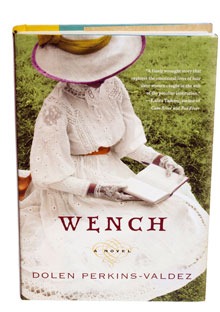
Wench by Dolen Perkins-Valdez – a Book Review

•November 30, 2010 • Leave a Comment

I was all set to give Wench by Dolen Perkins-Valdez a half nod when I remembered a survey type of conversation I participated in a few years back. The questions we [a bunch of writers loosely connected through an online writing board] were asked was this: if we lived as slaves in America, what type of slave would we be: the house negro or the Harriet Tubman/Nat Turner type. Most of the responses centered on being Black Moses and Turner.  The pollster said that she herself wasn’t sure. Her response made me think especially because I was one of those cleaving to the Tubman dynamic. All enslaved Africans didn’t adhere to flight/fight mode. What of those who bore the genocidal nature of chattel slavery silently? What of those whose names we don’t know because the only worthy thing they did was to survive? With this book, Wench, we find the story of four such characters – Lizzie, Rennie, Sweet and Mawu – some of whom possess the inclination to flee. The four women are brought together over a series of summers in the decade or so before the Civil War when their “owners” vacation at Tawawa House in Tawawa Springs, Ohio – a free state. [A brief history note – due to the continual presence of slaveholders and their slaves, the hotel started losing money. The hotel, the land and surrounding acreage was sold and very shortly thereafter became Wilberforce University, now the oldest African-American private university in the US]

The series of events that the four slave mistresses (and their male companions – both enslaved and free) experience during the course of a series of summers testifies to the will to survive – a will with a contrary existence in a society which thrived off negation of that selfsame will. My change of heart (from that initial half nod to one more affirming) came as I delved deeper into the book. Of particular interest was the main character, Lizzie [named Eliza but renamed Lizzie by her owner’s wife after he moved her into the big house].  She commits actions that a surface reading of would have one labeling her as a collaborator in her own oppression – not to say anything of the harm her actions inflict on other characters. However, as I read further, I realized that life under slavery wasn’t so black and white (no pun intended). It is quite effective the way in which Perkins-Valdez leads the reader into a deeper understanding of the nature of slavery to the point of saying maybe – maybe I would have been like Eliza – concerned most of all about my children – wondering what the “Master” would do to them if I broke and run. Maybe, falling into human puppy love with the person convinced he owns you and having sex with him was considered a workable exchange for learning to read – and subsequently reading stolen newspapers to those who share your bondage. Maybe. Just maybe. That maybe moves slightly in direction of potentiality when I read in the author’s note following the end of the novel that “it is believed that the children of the unions between the slave women and the slaveholders were among the early students at [Wilberforce]”.

The Resurrecting Writer Series: Jean Toomer

•November 16, 2010 • Leave a Comment

The writing prompt for this week’s participants in the Literary Blog Hop over at the Blue Bookcase website is what is the most difficult literary work you’ve ever read? What made it so difficult? The question immediately to mind the book I’m currently reading, Cane by Jean Toomer – and the problems I’m having finishing it. 

I have tried; sincerely, honestly tried. To be honest, it’s not because the book is unreadable or because I don’t like it. I do like it and it is readable. However, I’m finding it difficult to read Cane like a regular novel. There are no main characters and/or narrators. Perhaps I’m being too linear but it seems as if the only thing holding the diverse set of characters together is Sparta, the early twentieth-century rural Georgia town they all inhabit. Toomer wrote the town in such a way that it seems hell bent on being the stage on which the stories and poems are presented and he did so with a clear mastery of language. Cane is undeniably visual and therein lies the reason I find it difficult to read it continuously. The short prose pieces are so packed with imagery I think of them more as vignettes; literary vignettes I can put down, ponder over and return to.

As I end part one, I find myself putting it down to ponder some of the characters, particularly Karintha. On the surface, the two page chapter on Karintha appears to deal with what today would be called pedophilia:

Men had always wanted her, this Karintha, even as a child. Karintha carrying beauty, perfect as dusk when the sun goes down. Old men rode her hobby-horse upon their knees. Young men danced with her at frolics when they should have been dancing with their grown-up girls. God grant us youth, secretly prayed the old men. The young fellows counted the time to pass before she would be old enough to mate with them. This interest of the male, who wishes to ripe a growing thing too soon, could mean no good to her.

I found myself curious as to why Toomer, a Harlem Renaissance writer, would choose to start Cane with such a topic. Why have the opening gambit be a tale about how a young girl in the process of growing up became the town prostitute? In fact, the majority of the stories in the section I’ve read so far focus on women. So much so, that I found myself noticing similarities with some of Toomer’s literary descendants; particularly Alice Walker (setting) and Ntozake Shange (language).

I know Alice Walker read Toomer. In In Search of Our Mothers’ Gardens, she wrote the following:

A few of us will realize that Cane was not only his finest work but that it is also in part based on the essence of stories told to Toomer by his grandmother, she of the ‘dark blood’ to whom the book is dedicated, and that many of the women in Cane are modled on the tragic indecisiveness and weakness of his mother’s life. I also wondered if he received flack for writing about the abuse some black women experience as Walker and Shange did. Cane was for Toomer a double ‘swan song.’ He meant it to memorialize a culture he thought was dying, whose folk spirit he considered beautiful, but he was also saying good-bye to the ‘Negro’ he felt dying in himself. Cane then is a parting gift, and no less precious because of that. I think Jean Toomer would want us to keep its beauty, but let him go.

Well, as I said in the beginning, I am letting go of the book for now. What I term Cane’s vignette style, in my opinion, doesn’t support a straight through to the end type of reading. Nonetheless it is still highly valued literature for its written-with-love and extremely lyrical depictions of life in the town of Sparta, Georgia and I will definitely complete it.

Simply streaming day 2 (waiting on she)

•July 16, 2010 • 1 Comment

Over the past few days, I’ve had several blocks of time when I was all alone. Just me by my lonesome. And I loved it, every single millisecond! It tempts  me to issue a request of the universe and ask for one week; one week when my son is somewhere safe where he can have as much fun as his 6 year old self can handle; a week where I am totally alone: no 5:30 am wake-ups by bright brown eyes which look confused when I say it’s too early to go outside. Oh a week of not having to explain daily that during summer, Ra wakes up early and goes to bed late. A week of not having to plot and plan out meals. A week of watching stubby lil fingers zero in on the meat/chicken/fish to the exclusion of everything else. A week of not having to say eat your food or explain why it’s important to eat fruits and vegetables over and over again. A week where I wonder what on earth I was doing being a mother; let alone to this child who can manifest my best and worst qualities (mule headedness, intelligence, compassion, selfishness) in the space of one hour. A week where I learn to love the sound of my voice again.

So. Yes. So consider this my request, Universe. One week; a week, I want to specify, where my son is with someone who has his best interests at heart and who understand this parent’s need to not here daily reports. A person who will just send me pictures and not call me in a panic because mule headedness won out over other emotions.

simply streaming day 1

•July 16, 2010 • Leave a Comment

yesterday, i blogged under a new theme: simply streaming: writing whatever comes to mind and posting. i’ve decided to set myself the challenge of simply streaming for 30 days starting today. of course  being a writer, such posts will be edited – minimally.  as someone commented on a previous blog, i rarely use capitalization when i’m blogging. in fact, as a poet, i find the whole capital – lowercase thing problematic. i never like how my poems look when i use standard grammatical rules. poems are not novels. novels are supposed to have structure…even if it’s a deconstructed structure. so to free myself of constraints in this undertaking , you will rarely see capital letters in simply streaming. let the words flow like water…undammed.

shitty dreams. shitty dreamers. that’s just want floated through my mind at this moment in time. it’s a kinda harsh juxtaposition: shit and dreams. maybe that’s why i don’t like either kind. who knows. i do know that a decision i made about five years ago was the right one. i also begin to understand that why i entered this year thinking it’s gonna be my year. i thought whatever it was about this year that made it “mine”, was going to involve writing but now i realize it’s all about independence and declaring it. i am free now. the die is cast and it spells out amandla tichaona.

freedom, of course, is scary. scary and humbling. but every person in the world, i repeat, every person in the world deserves freedom simply by being born and as i so aptly wrote in my younger years: i wasn’t born to die.

the things children say

•July 16, 2010 • Leave a Comment

my child asked me the other day if someone we’re familiar with "thinks well"? i laughed and laughed. what a question from a six yr old! after i finished laughing (and calling everyone i know) i asked him "do you want the truth or a child appropriate answer?

he’s my child: he wanted the truth.

"some people just have ‘boo-boos’ in their head but don’t think they have boo=boos in their head. they think you have the boo-boo”. my son looked at my like i was crazy. i started laughing. “it’s true!” 

of course, being a child, he still wants to talk to this person. the innocence of children. such innocence is admirable but in the real world such innocence is at a premium. i can’t have my lil black star be a sitting duck for the irresponsible people {aka boo-boo heads”} of the world but what i’m realizing and accepting [with sincere thanks to the universe] is that it’s not my battle. it’s his.

my psyche will not be the landscape on which this “battle” will be fought; his will. my only duty to him in this matter is to make sure he comes through without a boo-boo of his own in his precious head.